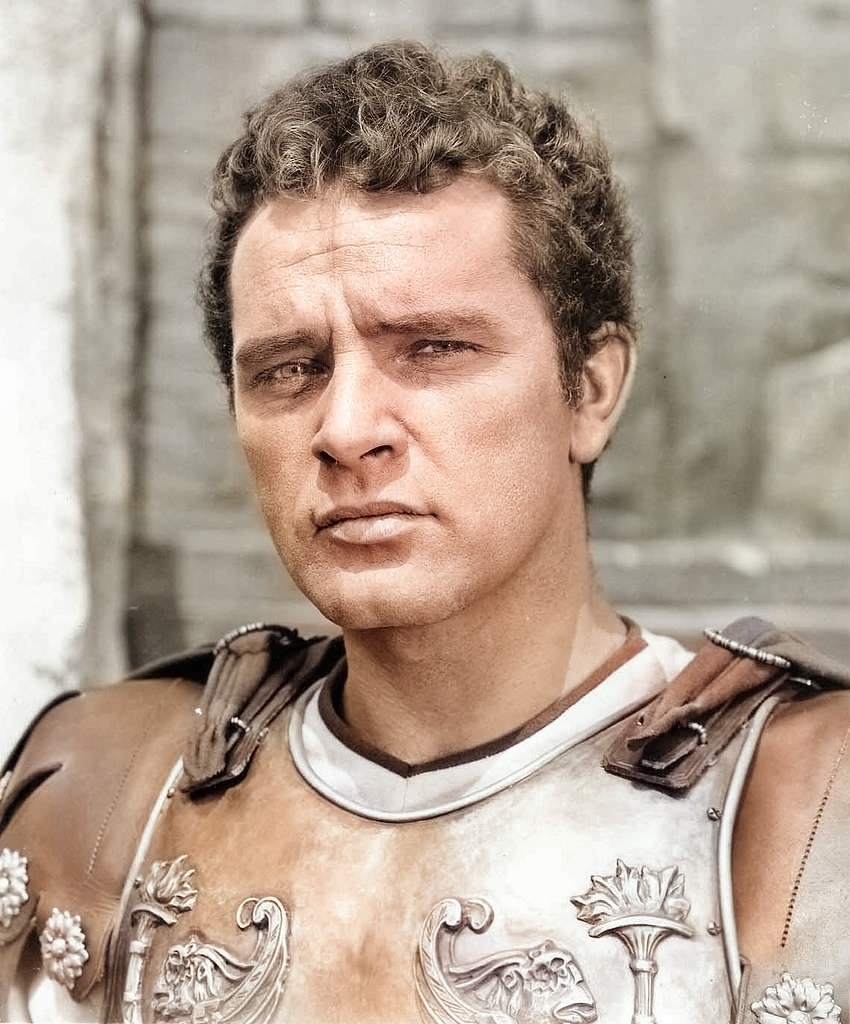
Richard Burton as Marcellus Gallio in The Robe, 1953

Richard Burton

Actor

Richard Walter Burton was born Richard Walter Jenkins Jr. on 10 November 1925 at 2 Dan-y-bont, Pontrhydyfen, a small mining village in the Afan Valley of West Glamorgan. He was the twelfth of thirteen children. His father, Richard Jenkins Sr., was a coal miner known to the family as Daddy Ni — a twelve-pints-a-day man who went off on drinking sprees and was largely absent. His mother Edith died in 1927 when Richard was just two years old. He was taken in and raised by his elder sister Cecilia, who became, in his own words, more of a mother than any mother could ever have been.

The decisive figure in his life was Philip Burton, a schoolmaster at Port Talbot Secondary School who recognised Richard's exceptional gifts and became his guardian in 1943 — allowing Richard to take his surname and the future Richard Burton was born. Philip drilled Shakespeare and poetry into him, taking him to the hillsides above Port Talbot to recite verse aloud to improve his voice projection. Burton would later say he would rather have played for Wales at Cardiff Arms Park than Hamlet at the Old Vic — but it was the stage that claimed him.

Spotted by the playwright Emlyn Williams in a school production, Burton made his professional stage debut in Williams's The Druid's Rest in 1943. He spent a short period at Oxford before serving in the RAF, and in 1948 made his film debut as Gareth in Williams's The Last Days of Dolwyn, a part written specially for him. On set he met Welsh actress Sybil Williams, whom he married in 1949. His theatre career accelerated rapidly — by the early 1950s he was being compared to Laurence Olivier, whom critic Kenneth Tynan called him the natural successor to.

The miner's son from Pontrhydyfen who became one of the greatest actors in the world — and never forgot where he came from

Hollywood beckoned after his acclaimed Broadway run in The Lady's Not for Burning (1950). By the mid-1960s, Burton was one of the highest-paid actors in the world, commanding fees of $1 million or more per film. His seven Academy Award nominations — for My Cousin Rachel (1952), The Robe (1953), Becket (1964), The Spy Who Came In from the Cold (1965), Who's Afraid of Virginia Woolf? (1966), Anne of the Thousand Days (1969) and Equus (1977) — remain a record for an actor who never won. He won a Tony Award for Camelot on Broadway, a BAFTA for The Spy Who Came In from the Cold, and a Grammy Award for a spoken word recording.

His relationship with Elizabeth Taylor — they met on the set of Cleopatra in 1963, married in 1964, divorced in 1974, remarried in 1975, and divorced again in 1976 — became one of the most scrutinised relationships in the history of celebrity. Together they made eleven films. Their finest collaboration was Mike Nichols's Who's Afraid of Virginia Woolf? (1966) — a film of such raw psychological power that it effectively broke Hollywood's Production Code.

Burton never lost his Welsh accent, never lost his love of rugby, poetry and Dylan Thomas, and never ceased to consider himself a miner's son from Pontrhydyfen. He is buried at Céligny, Switzerland, dressed in red — the colour of Wales. 2025 marked the centenary of his birth, celebrated with a BBC documentary Richard Burton: Wild Genius and the film Mr Burton, starring Harry Lawtey as the young Richard Jenkins finding his voice in the valleys of South Wales.

Career Highlights

  • Made his professional stage debut in Emlyn Williams's The Druid's Rest (1943), aged 17
  • Acclaimed on Broadway in The Lady's Not for Burning (1950) — compared to Olivier within a year of turning professional
  • First film role in The Last Days of Dolwyn (1948), written specially for him by Emlyn Williams
  • Seven Academy Award nominations — a record for an actor who never won — including Becket, Who's Afraid of Virginia Woolf? and Equus
  • Tony Award for Best Actor in a Musical for Camelot on Broadway (1961)
  • BAFTA Award for Best Actor for The Spy Who Came In from the Cold (1965)
  • Played Hamlet on Broadway (1964) in a record-breaking run of 137 performances — still the longest-running Hamlet in Broadway history
  • Narrated and performed Dylan Thomas's Under Milk Wood for BBC Radio (1954) free of charge, out of love for the work

ℹ️ Born Richard Walter Jenkins Jr. on 10 November 1925 in Pontrhydyfen, Afan Valley, West Glamorgan, Wales
ℹ️ Richard died of a cerebral haemorrhage on 5 August 1984 in Geneva, Switzerland, aged 58. He is buried at Céligny, Switzerland, in a red suit — the colour of Wales

Born in Pontrhydyfen, Afan Valley, Wales — grew up in Port Talbot, South Wales

Rich: The Life of Richard Burton — Melvyn Bragg
The authorised biography — Bragg had exclusive access to Burton's never-before-published private notebooks, covering 20 years of his most intimate thoughts. The definitive life of Wales's greatest actor.
The Richard Burton Diaries
Burton kept diaries throughout his adult life. Edited by Chris Williams, this selection reveals a man of extraordinary intelligence, wit and self-awareness — as funny and moving as anything he performed on screen.
Burton and Taylor at their incandescent best in Mike Nichols's landmark film
Who's Afraid of Virginia Woolf? [DVD]
Burton and Taylor at their incandescent best in Mike Nichols's landmark film — the one that broke Hollywood's Production Code and remains one of the finest pieces of screen acting ever committed to film.
Richard Burton: A Brother Remembered
Written with the co-operation of Richard Burton's surviving family, and with exclusive access to his letters and creative writing
From: ValleyVoice
Richard Burton was more than an actor to us in South Wales — he was proof that a boy from the valleys could conquer the world without ever pretending to be something he wasn't. That accent never changed.
From: ShakespeareMan
His Hamlet at the Old Vic in 1953 is still talked about as one of the greatest ever. The Old Vic was so packed they were turning people away. Olivier himself came to watch.
From: PontrhydyfenLocal
The village is so proud of him. The Richard Burton Trail runs through Pontrhydyfen — the house where he was born, The Miners Arms where his parents met, the aqueduct he played on as a boy. Well worth a visit.
From: FilmBuffDave
Seven Oscar nominations and never won one. That injustice still rankles. His performance in Who's Afraid of Virginia Woolf alone should have won twice.
From: CelticTiger
What people forget is he was a genuine scholar — spoke Welsh fluently, could recite endless poetry, read voraciously. He said 'the only thing in life is language.' That's a poet talking, not just an actor.